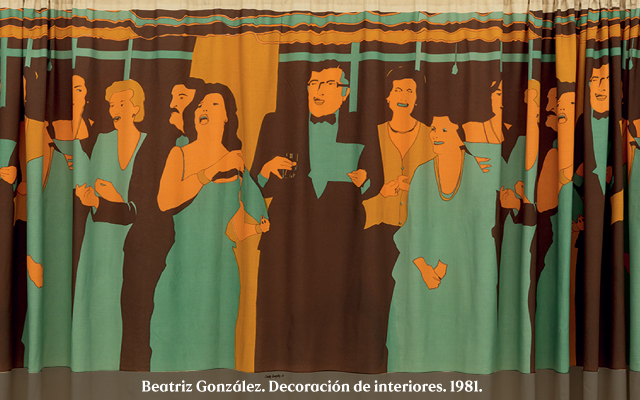
“You have taught us to SEE, raising to the realm of aesthetics those forms, colors, and images that in Colombia we had considered cheesy, vulgar, and unsightly. You found a way to appropriate all that and show it to us. You found a way to make us see it and appreciate it.
—Letter from Luis Caballero to Beatriz González, c. 1987
These words aptly sum up the legacy of Beatriz González (1932) in Colombian art and among artists of recent generations. The artist from Bucaramanga—who throughout her career has also been a researcher, curator, and teacher—is a keen observer of her surroundings and has found a style through which to represent it. In her body of work, mostly made up of paintings but also engravings, drawings, and installations, a Colombian sensibility takes center stage, with all the complexities and contradictions that it can include. The artist has drawn attention to the vices of the political class, the diversity of our popular culture, and the atrocities of the armed conflict, with a deep empathy for it victims.
Beatriz González: A Retrospective brings together more than one hundred works in various formats and media and reviews a career spanning six decades. The exhibition is organized by the Museum of Fine Arts, Houston (MFAH) and the Pérez Art Museum in Miami (PAMM), and curated by Mari Carmen Ramírez and Tobias Ostrander. It is considered the most complete exhibition of the Colombian artist to date, since it will also include a complementary exhibition that will open on October 30, in which her personal documentary and photographic archives will be on display for the first time. Other exhibitions by Beatriz González have been presented in European cities such as Bordeaux and Madrid , as well as 4in the Americas. The present exhibition represents an acknowledgement by the Banco de la República, who considers her to be a Master—yes, with a capital—who has played a central role in the art of our time.
Key information:
- Where and when. The exhibition is on display on the first and second floors of the Miguel Urrutia Museum of Art (MAMU), from October 15 to December 7, 2020. The opening panel will be hosted by the artist and curators and will take place virtually on Saturday, October 17 at 11:00 a.m. through the Banco de la República Museums Facebook page »
- How. Following biosecurity recommendations, entrance to the exhibition requires a reservation, which may be booked starting October 8. Groups of up to 7 people may book together. Schedule your visit »
- Virtual tour. The exhibition will also be available to virtual viewers. A digital exhibition as a timeline and a 360º tour will allow those who cannot visit the museum to enjoy all the works on display and appreciate the many details of the exhibition design.
- The Beatriz González archive. In dialogue with the retrospective, El Parqueadero—MAMU's artistic projects lab—will present an exhibition on one of Beatriz González's most intimate and least studied aspects: her role as an archivist. Curated by artists Natalia Gutiérrez Montes and José Ruíz Díaz, it opens on October 30. More info »
- Her apprentices. As part of the homage to the Master, her students give account of what González added to them academically, professionally, and personally. See the videos here »
A painter from the provinces
That is what González considers herself: a painter from the provinces, although not provincial. Her works reference domestic environments and local vernacular traditions, revealing a self-aware irony and a critique of middle-class notions of taste, class, gender, and ethnicity. She appropriates images from the Western art historical cannon and Colombian mass media through a particular model of figuration that includes the flattening of figures and the use of a strong color palette that evokes commercial advertising.
From the late nineteen sixties and into the seventies, the artist expanded her use of found images, drawing inspiration from cheap, popular reproductions of nationalist motifs and crime-scene photographs from newspapers, as well as politicians, religious leaders, and icons of international popular culture. The clippings she collected (representations of representations), mechanically reproduced and faded over time, reflect the sensibility of Colombian culture over those two decades, while serving to underscore the physical and virtual distance that separated Colombia from the centers of Western culture at that time. In the early seventies, González began to paint these images, as well as other works by Renaissance and Modernist masters, on the surfaces of cheap metal and wood furniture, thus creating some of her most iconic and celebrated works.
Uneasy court painter
González's art is also deeply related to Colombia's turbulent political history. In the early eighties, her strategy pivoted along the same lines as the country's cultural and political climate, greeted decades marked by corruption, political fragmentation, and violence. With irony and humor, González criticized the way the government represented itself in the media, particularly presidents Julio César Turbay Ayala and Belisario Betancur.
An image that embodies pain
The siege of Colombia’s Palace of Justice in 1985 represented a turning point in González's work. She herself recognizes that after this event her political and artistic position changed: "Colombia ceased being a comedy and became a tragedy." From then on, González's work turned towards representing the characters involved in the conflict, especially the victims. Thus, she abandoned what she called the "happy" colors (shades of pink and orange) and instead introduced tones that encompassed a wide spectrum of deep green, blue, yellow, purple, black, crimson, and chestnut, dense and mournful colors directly associated with blood and death.
This exhibition includes several examples from the series Las Delicias. Produced in 1996 and 1997, the paintings are based on images of the grieving mothers of 60 soldiers kidnapped by the FARC at the military base in the town of Las Delicias and held captive for 288 days. The series also includes a nude self-portrait in which the artist paints herself with her hands over her eyes. González has stated that her intention during this period was to "invent an image that embodied pain”.
"The critical perspective, sarcasm, and delicate observation of the country's cultural peculiarities make González' work an invaluable historical document for understanding the relationships between art and social criticism in the last century. Her unmistakable artistic language has been recognized with awards and in national and international exhibitions. Some of her works belong to museum collections in the United States, London, Spain, and Germany, but we can proudly say that a representative sample of her work is in the Art Collection of the Banco de la República and is part of this exhibition," says Ángela Pérez, deputy cultural director of the Banco de la República.