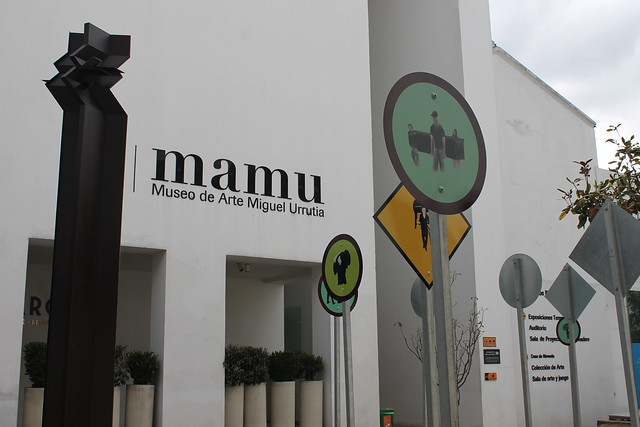
Banco de la República’s cultural activities in Bogotá take place in the Gold Museum, the Luis Ángel Arango Library and its Concert Hall, the Mint Museum, the Botero Museum, and the Miguel Urrutia Art Museum (MAMU). Each of these spaces hosts a wide range of cultural services and continuous programming, usually with free admittance or very affordable entrance fees for all audiences. Services include workshops to promote reading and writing, conferences, exhibitions, concerts, spaces for leisure, and research into archaeological, bibliographic, documentary, art, and numismatic collections.
History
The cultural activity of Banco de la República has its origin in Bogotá, shortly after the creation of the central bank in 1923. The history of the bank has always included cultural and artistic production in different regions of the country, and the central bank has long been involved in providing access to knowledge and caretaking heritage collections.
The first library of the Banco de la República gathered documentation and books on economic studies from around the country. It was located in the Pedro A. López building, the central bank’s first offices in Bogotá. Its collection started growing, including books on economic affairs, treasury records, and legal publications of the Conversion Board grew. Between 1932, when the first librarian was appointed, and the 1950s, Banco de la República purchased private libraries, opened a reading room with a capacity for 25 people, and first indexed its collection. It was not until 1958, when Luis Ángel Arango, the central bank’s general manager at the time, commissioned a public library from the architectural firm Esguerra Sáenz Urdaneta Samper.
On February 20, 1958, the Luis Ángel Arango Library was inaugurated in Bogotá, with a reading room for 250 people, an exhibition hall, and a music hall. To support the activities taking place in these spaces, the library began to publish the Cultural and Bibliographic Bulletin, still the institution’s official publication. In its almost 60 years of existence, the Luis Ángel Arango Library has become a cultural space of reference for cultural projects in Latin America, with very important documentary collections and a first class musical program in its Concert Hall.
The Luis Ángel Arango Library Concert Hall was inaugurated in February 1966. With its aim to be a major stage for chamber music in Colombia, its architectural design was carefully thought out in terms of acoustics, engineering, and aesthetics. The hall has a seating capacity of 367 and a stage for about 15 musicians playing live simultaneously. In addition, through its uninterrupted and varied programming, the hall has developed a musical tradition and become a national reference for the quality of its performers, composers, and audiences while not restricting itself to the repertoires of so-called classical music. Its history of concert programs includes a variety of ensembles that have performed jazz, popular music, and traditional music from various regions of the country.
In addition to classical music recitals, since the mid-1960s international musicians have graced the hall, from Ravi Shankar, the famous Indian sitar player, accompanied by Noder C. Mullinck on the tanpura; the jazz group Weather Report alongside the Austrian pianist Friederich Gulda; university choirs such as the Andrés Bello Choir from Chile’s Catholic University; contemporary ensembles Eighth Blackbird and Kronos Quartet; and many others.
The origin of the Gold Museum dates back to the mid-1930s, when the official interest in protecting and acquiring pre-Columbian pieces understood as part of the national heritage led the Ministry of Education to commission the central bank to "buy gold or silver objects manufactured by indigenous people for purposes of preservation."1; On December 22, 1939, Banco de la República purchased the Quimbaya Poporo, and the museum's collection was launched. With a collection of 14 objects, previously acquired by the bank, the museum was conceived as a means of preserving the finest objects of pre-Hispanic Colombian goldwork, which were rapidly exiting the country in the hands of private collectors.
The collection grew during the 1940s thanks to acquisition of private collections and began to be exhibited in the central bank’s boardroom. Between 1948 and the late 1950s, the museum continued its work, becoming a point of reference for nation’s pre-Hispanic past as it reaffirmed its intention to preserve and research the symbols registered on the artwork of Colombia’s pre-Hispanic indigenous peoples. Until 1959, the collection could only be visited by foreign dignitaries, diplomatic missions, and special guests, but the museum began to support the publication of research on pre-Hispanic archaeology with the intention of making it known to a wider public.
In 1959, after Banco de la República moved to its new location to the lot where the Hotel Granada had existed, the Gold Museum opened its doors to the public in the basement of the building. Since 1968, the Gold Museum has operated in its current venue, which houses the museum’s collections and organizes permanent, temporary, and itinerant exhibitions in coordination with other museums in the central bank's cultural network as well as in international spaces. It has also supported academic research, bolstering anthropology faculties and research institutions throughout the country and proposing advances in legislation for the protection of Colombian cultural heritage.
As for the history of museums, the cultural activities of Banco de la República began in the 1950s, after the opening of the Luis Ángel Arango Library. It was during those years that the bank's Art Collections got their start alongside a program of exhibitions of national and international artists. Since then, the organization of exhibitions and the conservation of the art and numismatic collections was carried out through the Museum of Religious Art (in operation from 1979 until the 1990s), the Exhibition House (in operation between 1996 and 2000), the Numismatic Museum (in operation between 1961 and 1985), the Mint Museum (1996), the Botero Museum (2000), and the Miguel Urrutia Art Museum (2004).
The Mint Museum, located in a colonial cloister at Calle 11 # 4-93, was the place where the first gold coins were minted in America in 1622. In 1961, the first Numismatic Museum was opened to the public, where the extensive collection of bills and coins issued by Banco de la República was exhibited for the first time. After the museum closed in 1985, the Mint Museum entered a process of comprehensive renovation and redesign. It opened to the public again in December 1996 with a curation based on the Banco de la República’s Numismatic Collection.
Referencias Bibliograficas:
1 Sánchez Cabra, Efraín. “El Museo del Oro” (The Gold Museum). Banco de la República Cultural and Bibliographic Bulletin, Volume 40. Issue 64. Bogotá, 2003. Volver arriba