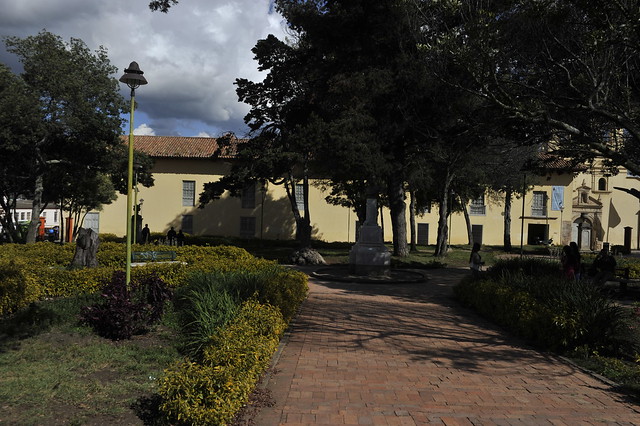
The Banco de la República Cultural Center in Tunja is a space for research, access to knowledge, and cultural encounters.
The San Agustín Cloister in Tunja, where Banco de la República cultural services in the capital of Boyacá are usually provided, is closed as part of a rigorous restoration process. During the construction process—estimated to be about four years, given the ambition of the project—the Cultural Center in Tunja will offer its services and programming in the Quiminza Theater located on Calle 20 # 8-66.
The Quiminza Theater location offers continuous access to library services and cultural programming, including training activities for librarians, workshops to encourage reading, conferences, national and international concerts, art exhibitions, and documentaries, among others activities. All this has earned the Cultural Center recognition from the people of Boyacá, who recognize it as a key element in the region’s cultural landscape.
An example of this is the strong commitment of the Cultural Center to the recovery, conservation, preservation, and dissemination of the documentary and cultural heritage of the department. Through these processes, adequate services for the population have also been consolidated, where technology is involved in order to ensure access to information among children, youth, and adults, as well as to promote reading and the acquisition of new knowledge. The Cultural Center in Tunja is recognized as an invigorating institution of regional culture, maintaining leadership and continuous strengthening the commitment to heritage that characterizes the central bank.
Learn more about the Quiminza Theater, the new venue of the Banco de la República Cultural Center in Tunja »
History
The Banco de la República Cultural Center in Tunja is usually housed in the San Agustin Cloister (currently being restored), a building that enjoys priority monumental conservation status. Besides being part of the National Monument that makes up Tunja’s historical city center, it is a place that preserves objects and memories that provide an account of their context of conception and planning from the 14th century to today.
Its history begins in 1549, when the Tunja town hall was asked for permission to establish an Augustinian convent in the colonial Plaza de Abajo. The request was denied and followers of Augustine were forbidden to open the convent in the city. In 1551, the Santo Domingo Convent was established in this place, composed of a house and a chapel with straw roofing. It was used for some time by the Dominicans, but considering how far away it was from the city center, they decided to move closer to the Plaza Mayor (where they are now), leaving the first colonial construction on the Cercado del Zaque abandoned, paving the way for the arrival of the Order of Saint Augustine.
The Augustinians finally established themselves in 1585. In 1586, Brother Lorenzo de Sufre presented church plans to the Tunja town hall. After a decision of the Royal Audience in favor of the Augustinians, construction began, and in the year 1659 works for the church and the convent were completed.
Having stayed active throughout the centuries and considered one of the most beautiful in the country, the building is representative of an architecture inspired by Seville and the Renaissance, composed of four double verandas, supported by Tuscan columns and semicircular arches that enclose the wide interior patio. In addition, a convent church attached, covered with mural painting that finishes off its façade in a slender stone bell-gable; to some the style is Mudejar baroque, to others mannerist. During restoration, a great many mural paintings corresponding to two different periods were discovered under coatings of plaster of the original walls. One in particular is of excellent quality and corresponds chronologically to the time of construction of the cloister and the church, representing scenes of the life of Saint Augustine. Another later one, from the early 17th century or early 18th century, fresher and more baroque, fills the space of the cloister with flowers. The Augustinians opened the novitiate with studies in grammar, arts, and theology at the end of the 16th century, at which time it was the second most important in the country. In the year 1821, the Augustinians were compelled to hand over the building to the School of Boyacá by to the new Law of Education, which ordered convents with fewer than eight devotees to close.
One year later, vice president Francisco de Paula Santander, created the School of Boyacá on May 17, 1822. A few years later, medicine, civil law, and canon law were incorporated to the curricular offerings. Later on, primary education under the Lancastrian System was established. In the year 1827, the University of Boyacá was founded by the Decree of January 5, 1828, signed by Liberator Simón Bolívar, and it began its work in the same year in the facilities of the San Agustín Cloister. The cloister was returned to the Augustinians between 1829 and 1831, and the school and university were moved to the Convent of the Society of Jesus.
Under the direction of the clerics of San Juan de Dios, the cloister was converted into a hospital from 1835 to 1859. During the Civil War of 1860, it was used as army barracks. The then-president of the State of Boyacá, General Sergio Camargo, issued the Decree on February 10, 1863, establishing that the cloister would be the penitentiary of Tunja. Through the Law of Disentailment of Goods from Dead Hands, the cloister definitively became the property of the nation of Colombia. Thus, for a century, the cloister housed all kinds of prisoners from various regions of the country until 1966, when the panopticon was moved to the village of El Barne. Over the years, the San Agustin cloister entered into architectural decline, and so the government decided to hand over the property to the School of Boyacá.
Given the historical and architectural importance of the cloister to Boyacá and the country and the high costs of restoration, Banco de la República decided to finance the works through the Foundation for the Conservation and Restoration of Colombian Cultural Heritage.
The project was directed by the architect Álvaro Barrera, who described in his study the disappearance of 60% of the cloister, destroyed and looted after being abandoned as a penitentiary, with only one of the four verandas of the old cloister still standing. Barrera proposed to restore the part of the convent that was still standing and proposed the reconstruction of the missing space and volumes, using the same architectural language but with a modern interpretation of it, reproducing the non-existent arches with metal in the original forms and replacing the lost walls with large panes of tempered glass, applying Colombian technology throughout the whole process.
On March 28, 1981, the School of Boyacá handed the cloister over to the Foundation for the Conservation and Restoration of Colombian Cultural Heritage through a loan agreement. In the year 2004, by common agreement, the bailment was cancelled. A similar exchange took place between the School of Boyacá and the Banco de la República, so that the San Agustin Cloister became the bank’s property.
On October 21, 1988, the cloister was recognized as a cultural area of Banco de la República and the library was inaugurated, initially named after Alfonso Patiño Rosselli. From that moment until the early twenty-first century, cultural activities have been held, promoting library services, appreciation of academic music and the visual arts, and offering educational exhibitions for the benefit of the city and the community on Tunja. At present, the former cultural area is undergoing a process of resizing, set to reopen as a Cultural Center with a full suite of services, collections, and programming organized by Banco de la República’s Cultural Department.